
A beautiful garden to lift your soul
20 April 2026
3 min read
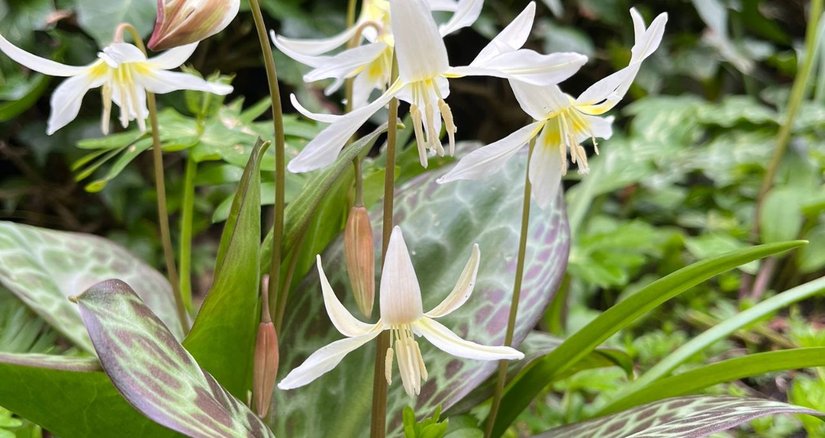
April has a particular way of arriving, as though it has been waiting just beyond the hedge for the right moment to step in. One day the garden is held in a kind of thoughtful pause, and the next it is speaking, softly at first, then with gathering confidence.
It is in this threshold month that I find myself returning, almost instinctively, to York Gate, as much as for reassurance as for pleasure. There is something about being a regular visitor to a garden that alters your perception of time. You begin to notice not just what is present, but what is becoming. The garden is no longer a static composition but a sequence of arrivals, each one subtle, each one carrying its own quiet charge of anticipation. April, more than any other month, feels like a conversation between what has been and what might yet be.
At York Gate, the first voices in that conversation belong to the fawn lilies. They are never ostentatious, never seeking attention in the way of tulips or daffodils, but instead seem to hover just above the ground, their petals reflexed like the wings of something newly landed. Their colouring, those washed-back creams and soft yellows, sometimes with a blush or a freckle, feels almost provisional, as though the plant itself is still deciding how bold it dares to be this year. I always have to slow down to see them properly. And in that act of slowing, something shifts internally: the mind loosens, the body settles, and the smallness of the flower becomes a kind of lens through which the wider world sharpens.
Not far from them, the white border is beginning to gather itself. In high summer it will be a study in luminosity and restraint, but in April it is more like a sketch, lines and hints and emerging textures. There are pale shoots pushing up through the soil, the first tentative leaves unfurling, and here and there a suggestion of the structure to come. It is a reminder that beauty in gardens is not only about fullness or climax; it is equally about these early gestures, these half-formed intentions. The border feels alive with promise, and that promise is curiously uplifting. It invites you to imagine forward, to participate in the making of the season.
Elsewhere, the garden offers its quieter details: the fresh gloss of new foliage catching the light; the intricate tracery of emerging ferns; the soft, almost edible green of spring growth in the hedging and underplanting. Even the paths seem different in April, edged with a looseness that will soon tighten as growth accelerates. There is birdsong, of course, always birdsong, but it feels more urgent now, as though the garden itself is being narrated into life.

And then there are the hostas, still in their pots, their presence marked more by expectation than by form. I find myself checking them each visit, looking for the first tightly furled tips breaking the surface, those pale, almost luminous spikes that will unfurl into generous leaves. There is something deeply hopeful in this stage of the hosta’s life, the sense that abundance is already encoded within that small, emerging point. It is a kind of assurance that growth will come, that fullness is on its way.
What strikes me, walking through York Gate in April, is how restorative this attentiveness becomes. The garden does not overwhelm; it invites. It does not demand admiration; it rewards noticing. In a world that so often pushes us towards speed and distraction, a garden at this time of year offers a counterpoint, a slower rhythm, a gentler way of seeing.
You leave not with the memory of a single, spectacular display, but with a collection of small impressions: the tilt of a fawn lily, the pale stirrings in the white border, the promise held in a pot of hostas. And these impressions linger. They soften the edges of the day, lift the spirits in ways that are difficult to articulate but unmistakable in their effect.
April, in the garden, is not about certainty. It is about emergence, about the delicate unfolding of possibility. And perhaps that is why it feels so necessary. In witnessing the garden’s tentative steps into the season, we are reminded, gently, persuasively, that renewal does not arrive all at once. It begins, as it does here, with the smallest of signs.