
Celebrating Moths at Fullers Mill Garden
5 June 2026
3 min read
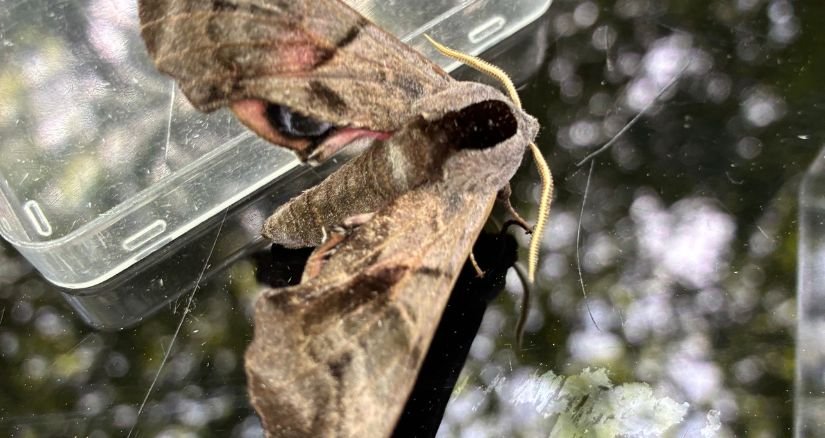
Local volunteer and wildlife expert, Peter Lack, has been monitoring the moths at Fullers Mill Garden for the last year, with records of his findings shared with the County Recorder.
This year Peter agreed to run a demonstration to coincide with Garden Wildlife Week this May. Peter set two traps overnight and shared his findings with garden visitors the following morning.
Peter commented “I had a steady flow of people showing interest throughout the morning where I had time to talk to and explain what things were and how I monitor the moths.”
Fewer moths were caught compared to a visit the previous week, perhaps attributed to no cloud cover and a nearly full moon, however, 161 moths of 52 species were trapped and identified. These included two species of Hawk Moth, two of the beautiful Elephant Hawk Moth - which were pristine so Peter suspects they had probably emerged overnight - and a Poplar Hawk Moth.
Peter said: “I also captured two Peppered Moths. This is the species which is a classic for genetic studies as the melanic (black) form got quite common near industrial cities about 100 years ago before the clean air acts but has since declined as lichens etc have returned to tree trunks. Birds could find "peppered" ones on black tree trunks and therefore eat them and the reverse on industrially blackened tree trunks leading to the classic example of natural selection at work.”
Other species included:
- A very early Light Arches
- the Breckland speciality Clouded Buff
- several Cinnabar
- Burnished Brass
- White and Buff Ermine
- a Figure of 80
- Scorched Wing and several others I had not seen at Fullers Mill previously.
Peter will continue to run traps every now and again during this summer. The overall total is now 236 different species with 86 so far recorded over two visits in 2026.

In 2025 five visits from June to August identified 1,111 different moths covering a wonderful 197 species, some quite uncommon or rare. Those that proved tricky to identify were checked by experts to confirm their species.
These included lesser-known species such as the Large Clouded Knot-horn (Homoeosoma nebulella), one of which was recorded at Fullers Mill Garden in August 2025. Peter said: “this is decidedly uncommon and has only been seen once before in the 2-km square (in 1985). I have had a couple of records in my garden (quite nearby) but if you look at the map for the species on suffolkmoths.co.uk you will see that it only really occurs in the Brecks and a few on the coast and even then it is rare.”
He added, “I was delighted to record the Dotted Clay (Xestia baja). Definitely the "star moth" of the year. There have only been six Suffolk records since 2020 - apart from in a garden on the eastern edge of Brandon by the Little Ouse where there have been several records in most years recently.”

Others included Small Seraphim (Pterapherapteryx sexalata) and Webb's Wainscot (Globia sparganii) which are uncommon inland, although more common along the coast.
The more common species identified include the Common Wainscot (Mythimna pallens), Dingy Footman (Eilema griseola), Mother of Pearl (Patania ruralis) and Bird-cherry Ermine (Yponomeuta evonymella).
Peter also noted 43 Buff Arches (Habrosyne pyritoides) trapped in June and July, explaining that “the 41 trapped on 3 June is by far the highest I have ever caught in one trap, there’s normally only 2 or 3 maximum.”
There was also a good range of Hawk Moths (five species).
Annie Dellbridge, Garden Manager at Fullers Mill Garden said: “it’s so wonderful to know that our beautiful garden is home to so many different species of moth. Whilst we don’t necessarily have specific nature habitats, we have a garden that is so rich in wildlife it is really something to celebrate.”