Moments of May: Colour, Curiosity and Conservation
6 May 2026
4 min read
As spring settles into early summer, gardens across the country are finding their rhythm, bulbs giving way to fresh foliage, woodland treasures emerging and meadows beginning to stir. May is a month of transition, full of energy and promise, and two very different gardens are showcasing just how diverse and exciting this time of year can be. From bold experimentation and standout specimens to quieter, more naturalistic displays, both York Gate and Fullers Mill Gardens offer visitors plenty of reasons to explore in the weeks ahead.
York Gate Garden – A Season of Experimentation and Surprises
York Gate has burst into life this year with a real explosion of colour, led by some particularly strong daffodil displays. For the first time, we extended this into a large pot display at the back of the café, selecting a mix of trusted favourites alongside a few new (to us) varieties to bulk out the show. There’s always a degree of anticipation when trying something new - catalogue descriptions can only tell you so much, and colours don’t always appear quite as expected. Seeing them in situ is the real test.
One standout success was Narcissus ‘Rip Van Winkle’, which featured in several bowls dotted throughout the garden. It barely resembles a traditional daffodil at all, instead looking more like a miniature yellow cactus dahlia, and it certainly drew attention. Not everything, however, was quite so well received. A large pot of Narcissus ‘Cum Laude’, a tall split-corona variety with an apricot-pink centre, divided opinion, but ultimately not in a good way. It’s safe to say this one won’t be making a return appearance.

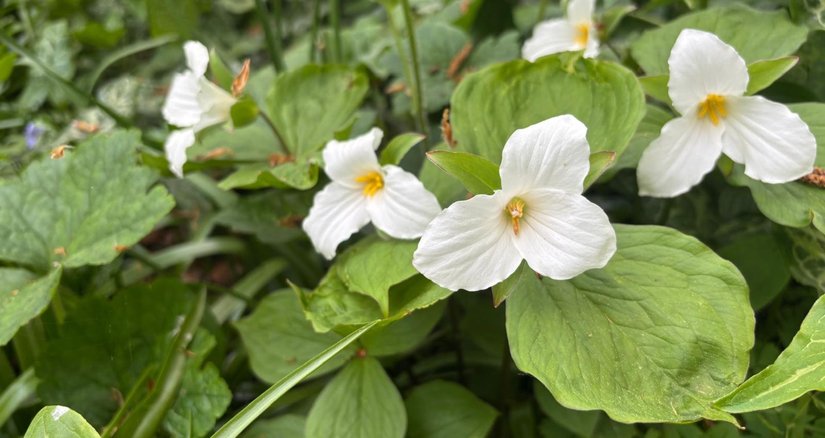
Elsewhere, our trilliums have been exceptional this year. The cool spring and consistent early rainfall seem to have created ideal conditions, and for the first time, at least in recent memory, we’re seeing Trillium grandiflorum seedlings emerging in The Dell. It’s a small but significant sign that the plants are not only thriving but beginning to establish themselves more naturally within the garden.
One of the more unusual highlights this month has been Amorphophallus konjac, a relative of the infamous titan arum. While it doesn’t yet rival its larger cousin, it certainly shares its dramatic flair. Producing a single large, divided leaf, it is in bloom right now, having sent up its distinctive deep purple flower, complete with its famously unpleasant scent. It’s not for everyone, but it’s undeniably fascinating.

Looking ahead through May, York Gate continues to evolve, with layered planting combinations and unexpected moments around every corner. It’s a garden that rewards close attention and repeat visits: there’s always something new to discover, whether it’s a subtle planting detail or a bold horticultural experiment.
Fullers Mill Garden – Embracing Nature and the Spirit of May
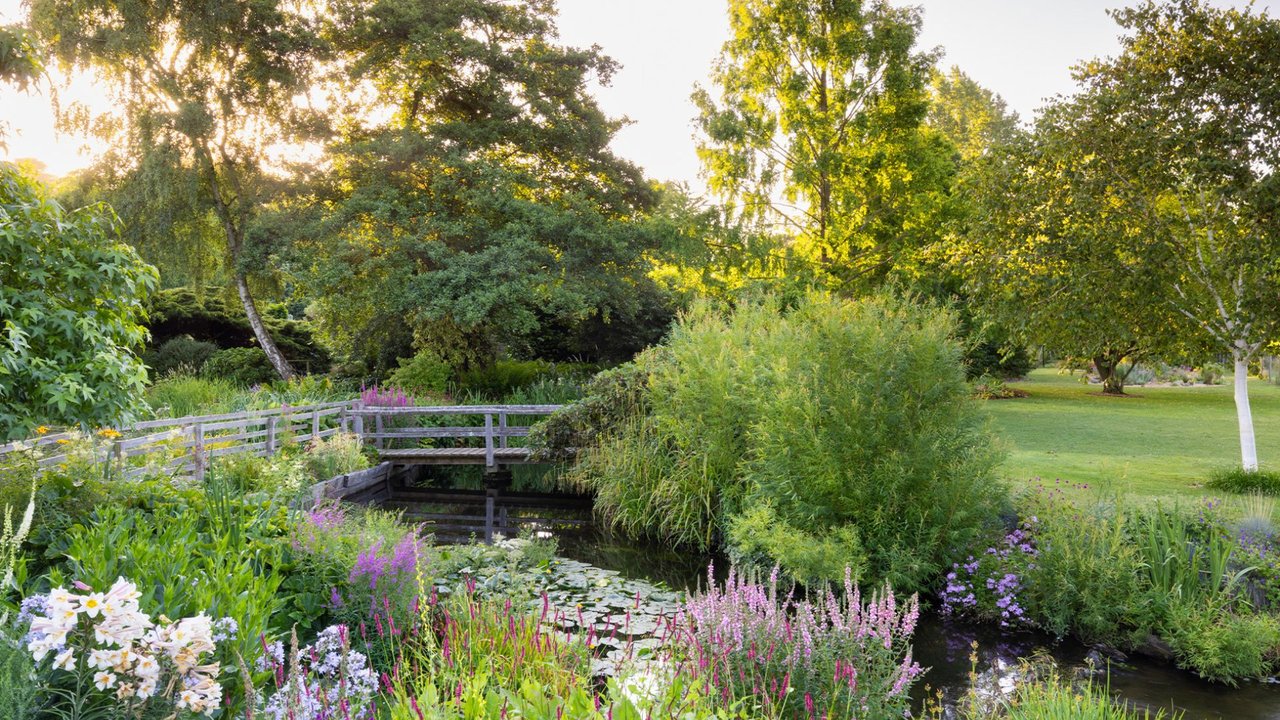
As May begins at Fullers Mill, the garden takes on a softer, more naturalistic feel, with wildflowers beginning to emerge across the landscape. Around the lake and through the surrounding pine woodland, there’s a growing sense of seasonal change, as native species come into their own. In the King’s Forest, large groups of foxgloves (Digitalis purpurea) are already making an impression. These thrive particularly well in disturbed ground, and visitors can enjoy them even before reaching the garden proper, lining the track from the road to the car park.
Within the garden itself, one of the key areas to watch is The Strip, an elongated stretch of longer grass running alongside the lake. Here, a carefully managed meadow-style planting is developing, with cowslips currently in flower and more to come as the season progresses. Knapweed, scabious and ox-eye daisies will follow later in the summer, gradually building a rich and varied display.
A particularly important player in this setting is yellow rattle, a hemiparasitic plant that draws nutrients from surrounding grasses. By weakening the grass growth, it creates space for less competitive wildflowers to establish and flourish. It’s a subtle but highly effective way of shifting the balance in favour of biodiversity.
This approach ties in closely with the principles of No Mow May, a movement that encourages gardeners to leave their mowers in the shed for the month. At Fullers Mill, this isn’t just about reducing maintenance, it’s about actively supporting wildlife. On a warm day, the longer grass hums with insect life, from pollinators feeding among the flowers to the many other species that rely on this habitat. Rather than cutting everything back at the start of June, visitors are encouraged to think differently, perhaps by mowing pathways through the grass while leaving the majority undisturbed for longer.
With warmer days and longer hours of sunlight just around the corner, this is one of the most rewarding times to visit. The gardens feel alive, not just with plants but with the activity of the wildlife they support. It’s also a timely reminder for those working outdoors to take care; sun hats, high-factor sunscreen and plenty of water are essential as the season shifts.
The gardens in May celebrate natural processes, places where patience and light-touch management allow nature to put on its own show, one that evolves week by week and is well worth returning to see.
We look forward to welcoming you to our gardens Wednesday to Sunday (and bank holiday Mondays) from 10am from April to October.