
The Wisdom of Gardens: Reflections on Mental Health at York Gate
5 May 2026
4 min read
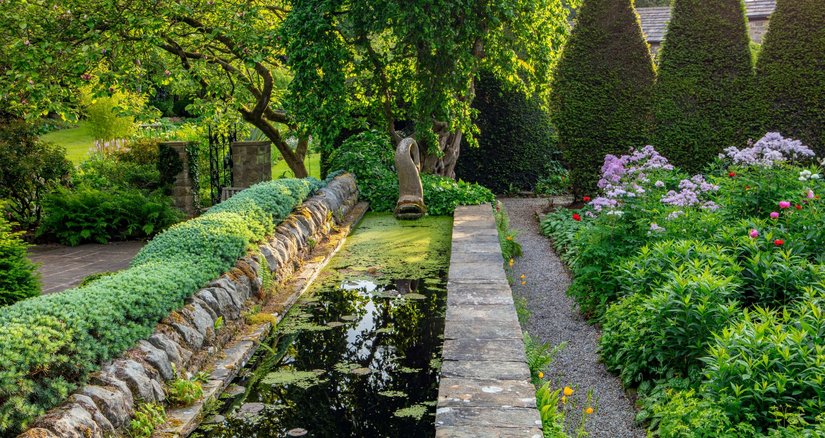
There is a particular quality of stillness that settles upon a garden in the early morning, before the world has fully woken and begun its clamour. I have come to believe this stillness is not merely the absence of noise, but something more profound, a kind of presence that gardens offer to those who are willing to receive it. As Mental Health Awareness Week invites us to consider the wellbeing of our minds and spirits, I find myself drawn inevitably to what gardens can teach us about tending to ourselves.
Those of you who know York Gate will understand immediately what I mean. That extraordinary acre has always struck me as a garden that asks only that you be present in exactly the space you occupy. The miniature pinetum, the dell, the herb garden, the white border, each demands nothing more than your willingness to notice. In an age when we are constantly bombarded with stimulation, when our attention is fractured into ever smaller pieces, this is no small gift.
The notion of garden rooms resonates deeply when we consider our mental landscapes. We too contain multitudes, spaces within ourselves that serve different purposes, hold different memories, require different kinds of attention. Some of these inner rooms are sunlit and welcoming; others we may have neglected or closed off entirely. York Gate suggests a wisdom we might apply to our own interior territories: that each space deserves acknowledgment, that transitions matter, and that the whole is enriched by the thoughtful cultivation of its parts.
Mental health, I have come to understand, is not a destination at which we arrive but a practice we undertake daily, much like gardening itself. There are seasons of growth and seasons of dormancy. There are times when we must prune back what no longer serves us, and times when we must simply wait, trusting that what we have planted will eventually emerge. The gardener learns patience not as an abstract virtue but as a practical necessity. Seeds do not germinate according to our schedules. Neither, often, do we.
I think of the Spencer family working their plot year after year, making countless small decisions that accumulated into something extraordinary. Frederick, Sybil, and Robin gave their lives to that acre of ground, and in doing so created a legacy that continues to nurture visitors decades after their passing. There is something profoundly hopeful in this, the recognition that our efforts, however modest they may seem in the moment, can ripple outward in ways we cannot foresee. Every act of care matters, even when we cannot perceive its effect.
Walking through York Gate's interconnected spaces, one experiences something that feels increasingly rare: permission to slow down. The garden does not hurry you along. It offers benches, pauses, moments of enclosure followed by sudden openings. This rhythm of compression and release, of intimacy and prospect, mirrors something essential about emotional wellbeing. We need both shelter and horizon, both the known and the possible.
The physical act of gardening offers its own form of restoration, though I am wary of reducing it to mere prescription. There is genuine healing in the feel of soil between one's fingers, in the rhythm of repetitive tasks like weeding or deadheading, in the honest tiredness that comes from working outdoors. These things are good for us not because they have been proven in clinical trials, though they have been, but because they connect us to something older and more fundamental than our modern anxieties.
When we garden, we participate in cycles that predate human consciousness and will continue long after we are gone. This perspective, far from being dispiriting, can be profoundly liberating. Our troubles, real as they are, exist within a larger context. The blackbird singing at dusk does not know or care about our deadlines and disappointments. The emerging bulbs push upward regardless of the news cycle. Nature offers us, if we will accept it, a sense of proportion.
York Gate achieves something remarkable in its compression of so many different experiences into such a modest footprint. This too carries a lesson. We need not have vast resources or unlimited time to create moments of beauty and meaning. A single pot on a windowsill, tended with attention, can offer something essential. A few minutes spent noticing clouds move across the sky costs nothing and excludes no one. Caring for our mental health need not be elaborate or expensive to be effective.
I am conscious, as I write this, that some who read these words may be struggling in ways that a garden visit alone cannot address. Mental health conditions are real and sometimes require professional intervention and sustained support. Gardens are not a substitute for these things, nor should they be presented as such. What they offer, rather, is a complement, a space where healing can be supported and where therapy can find practical expression.
Perennial exists precisely because those who work in horticulture face the same mental health challenges as everyone else, often compounded by the physical demands and financial precariousness that characterise much work in this sector. It is fitting that an organisation dedicated to supporting gardeners should also advocate for the mental wellbeing that gardens themselves can promote. Those who give so much to creating beauty for others deserve support in return.
As Mental Health Awareness Week encourages us to speak more openly about our struggles and to seek help when we need it, let us also remember the wisdom that places like York Gate embody. That small spaces can contain great meaning. That patient attention yields rewards. That we are part of something larger than ourselves. And that sometimes, the most radical act of caring for ourselves is simply to step outside, notice what is growing, and allow ourselves to be, for a moment, still.
- Andrew Jackson

Confident Conversations' - Mental wellbeing awareness webinars
Mental wellbeing is a major issue within the horticulture industry. Our webinars give you the tools to talk to people with confidence.

Exploring our health and wellbeing platform
Kickstart your physical and mental health today with our free app.